

Same Day Printing Pricing Guide: Costs & Turnaround

Table of Contents
How Same Day Printing Pricing Works: What Drives Your Cost
Quantity and Page Count
Color vs. Black-and-White and Paper Stock
Same Day Printing Cost: Typical Per-Page and Per-Item Ranges
What Actually Moves the Price: A Fee Breakdown
Worked Examples: What Common Jobs Cost
Document Printing: Copies, Letter Size, and Per-Page Pricing
Marketing Materials: Business Cards, Flyers, Posters, and Banners
Same Day Business Card Printing: Costs and Ordering Steps
What Drives the Cost of a Box of Cards
The Ordering Process, Step by Step
How to Keep a Card Order on Budget
Business Card Printing Turnaround Time and Order Cutoffs
Print-Ready File Requirements for Same Day Printing
How to Reduce Your Same Day Printing Cost: Practical Steps
Frequently Asked Questions
Last Updated: October 9, 2026
How Same Day Printing Pricing Works: What Drives Your Cost
Same day printing pricing is determined by four variables: quantity, page count, color mode, and paper stock.
At Full Color Business Cards and Flyers in 1 Day, we quote every job against those same four variables.

Quantity and Page Count
Printing costs drop as quantity rises. Setup, plate preparation, and machine calibration are fixed costs, so a run of 100 copies spreads those costs across more units than a run of 10.
Page count works differently. A 20-page document costs more than a 2-page document at the same quantity because each page consumes press time and paper. If your budget is tight, ask whether every page earns its place.
Color vs. Black-and-White and Paper Stock
Black-and-white printing costs less than full color because it uses one toner channel instead of four. For internal documents, drafts, and forms, black-and-white is the sensible default.
Paper stock adds cost through weight and finish. Standard 80 lb text paper is the affordable workhorse. Heavier cardstock, matte coatings, and soft-touch laminates push the price up, but they also change how the piece feels in a prospect's hand.
Key Takeaway Quantity, page count, color mode, and paper stock are the only four variables that move your price. Everything else is a rounding error.
Same Day Printing Cost: Typical Per-Page and Per-Item Ranges
Same day printing cost varies by product, so per-page pricing only makes sense for documents. Per-item pricing is the correct measure for cards, flyers, and signage. The table below shows how each category is priced and which variables move the number most.
Product | Priced By | Main Cost Drivers | Turnaround Impact |
Document copies | Per page | Color mode, page count, paper | Same-day available |
Business cards | Per box of 100 | Stock weight, finish, quantity | Same-day available |
Flyers | Per unit | Size, color, paper, quantity | Same-day available |
Posters | Per unit | Dimensions, material, finish | Same-day available |
Banners | Per square foot | Size, material, grommets | Same-day available |
What Actually Moves the Price: A Fee Breakdown
Most shops quote a base price and then add line items. Knowing which line items exist lets you predict the total before you call. The common variables are:
Setup or plate fee. A one-time charge per job, sometimes waived above a quantity threshold. It is why a 10-piece run costs more per piece than a 500-piece run.
Paper stock. Standard 80 lb text or 14 pt cardstock is the baseline. Heavier cover stock, matte or gloss coating, soft-touch lamination, and specialty substrates each add cost.
Color coverage. A page that is 5% ink and a page that is 100% ink can price differently on digital presses that meter toner. Full-bleed color costs more than a text-only page.
Finishing. Cutting, folding, scoring, perforating, stapling, grommets, pole pockets, hemming, and mounting are each separate operations with their own charge.
Minimum order. Many shops have a minimum dollar amount or minimum quantity per product. A single poster may carry the same minimum as five.
Key Takeaway Ask for a quote that itemizes setup, stock, finishing, rush, and delivery separately. A single lump-sum number hides which lever you can pull to lower the bill.
Worked Examples: What Common Jobs Cost
Exact prices vary by shop and region, but the structure of a quote is consistent.
Example 1: 100 black-and-white letter-size documents, single-sided, standard paper. Priced per page.
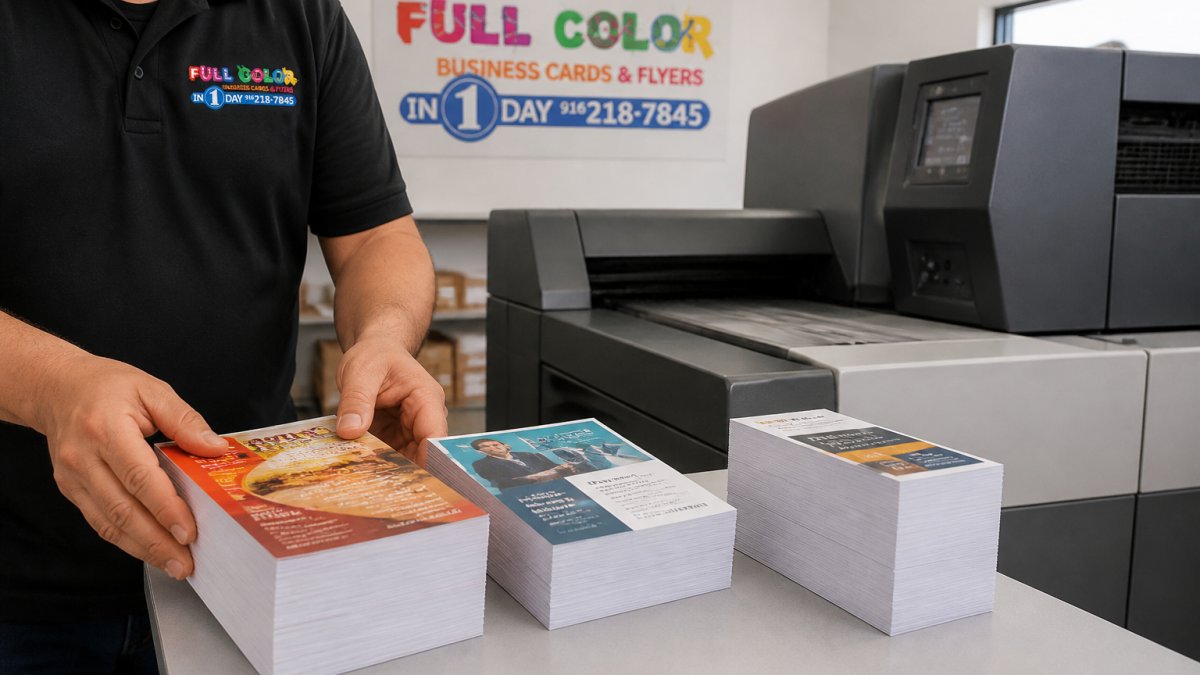
Example 2: 100 full-color flyers, 4x6 inch, standard gloss text paper. Priced per unit.
Example 3: One 24x36 inch poster on standard poster paper. Priced per unit and driven by dimensions and material.
Document Printing: Copies, Letter Size, and Per-Page Pricing
Document printing is priced per page, with letter size as the standard. Black-and-white copies on standard paper sit at the low end of the range. Full-color pages cost more because four toner channels run instead of one.
Volume changes everything. A short run of a few dozen pages carries a higher effective per-page rate than a run of several hundred, because setup is amortized across fewer sheets.
Marketing Materials: Business Cards, Flyers, Posters, and Banners
Marketing materials are priced per item or per square foot, not per page. Business cards are sold in boxes of 100. Flyers are priced by size and quantity.
Large-format printing adds finishing costs that small-format work does not: grommets, pole pockets, hemming, and mounting all carry their own line item. If your banner needs to hang outdoors, factor those in before you compare quotes.
Watch Out Comparing a per-page document quote against a per-item flyer quote is meaningless. Match the unit of measure before you decide which option is cheaper.
Same Day Business Card Printing: Costs and Ordering Steps
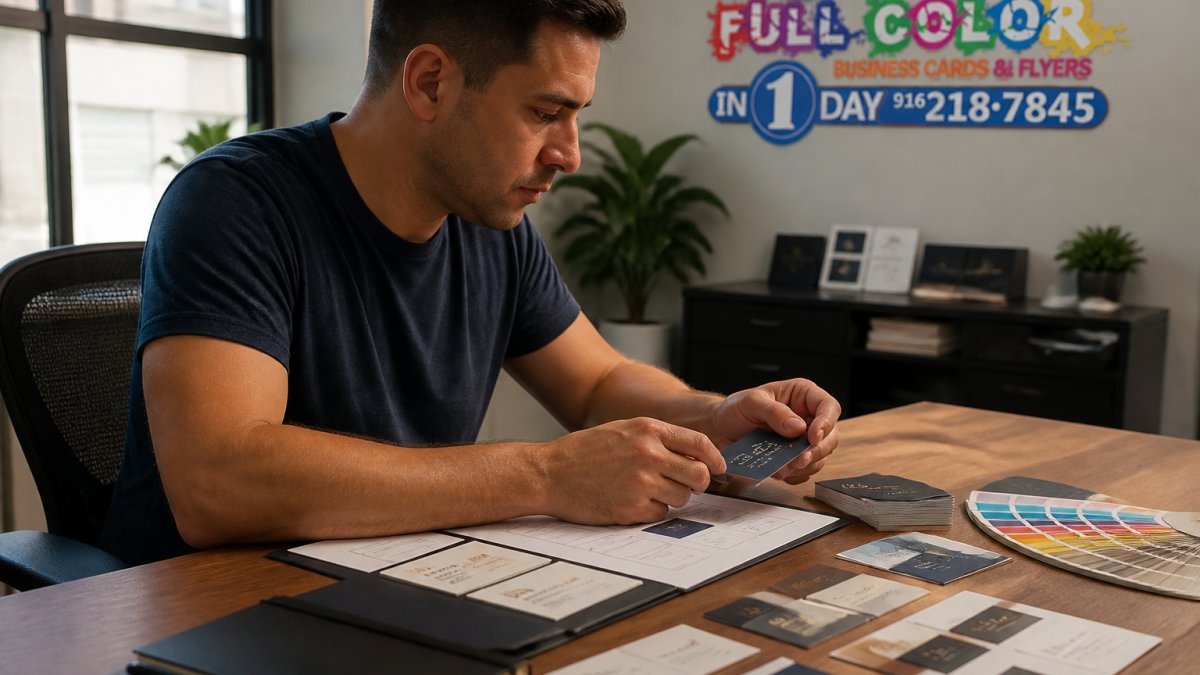
Same day business card printing is priced per box, typically in 100-card increments, with stock weight and finish as the main variables. Standard 14 pt cardstock with a matte or gloss coating is the most economical option; heavier stocks, soft-touch lamination, and spot treatments cost more.
What Drives the Cost of a Box of Cards
Four variables set the price of a card order, and they interact:
Quantity. Cards are sold in 100-card boxes. The per-card rate drops as the box count rises because setup and plate costs spread across more units. Buying 500 cards usually costs less per card than buying 100.
Stock weight. 14 pt is the standard thickness. 16 pt and 18 pt feel more substantial and cost more. Specialty stocks, kraft, cotton, or metallic, carry a premium.
Finish. A matte or gloss aqueous coating is the affordable default. Soft-touch lamination, spot UV, foil stamping, and embossing are premium finishes that each add a separate line item.
Sides. Single-sided cards cost less than double-sided, since the second side runs the press again.
A common pattern is that the finish, not the stock, is the biggest swing factor. Soft-touch lamination on 14 pt stock can cost more than plain 18 pt stock, so decide which matters more, feel or thickness, before you lock the spec.
The Ordering Process, Step by Step
Choose your quantity, stock, and finish
Upload a print-ready file or request design support
Approve the digital proof
Pay and confirm your pickup or delivery window
Collect your cards at the scheduled time
We offer semi-custom design services, so you do not need a finished file to start.
How to Keep a Card Order on Budget
Order the quantity you will actually use. Cards do not expire, but a 1,000-card run ties up budget you may need for flyers or signage.
Skip premium finishing on the first run. Prove the design works before you pay for foil or spot UV.
Submit a print-ready file. A file that needs rebuilding can trigger setup charges and push your job past the cutoff.
Confirm the cutoff before you commit. Same-day card service depends on file readiness and queue position, not just the product.
U.S. Small Business Administration guidance on marketing your business notes that consistent branding across printed materials helps small businesses build recognition, which is one reason card quality matters more than card quantity.
Business Card Printing Turnaround Time and Order Cutoffs
Business card printing turnaround time depends on when you order, not just what you order. Same-day service requires your file to be approved and in the production queue before the shop's cutoff. Miss it by an hour and your job moves to the next business day.
Cutoffs vary by shop and by product. Documents and cards generally have later cutoffs than large-format signage, because banners require more machine time and finishing.
Two things slow orders down more than anything else:
Files that are not print-ready, forcing a rebuild before production
Proofs approved late in the day, after the queue has closed
Pro Tip Submit your file the night before and approve the proof first thing in the morning. You move to the front of the queue without paying a rush fee.
Print-Ready File Requirements for Same Day Printing
Print-ready file requirements exist because a file that looks correct on screen can fail on press. Meeting them before you submit is the fastest way to protect your deadline.
Resolution: 300 DPI at final print size. Web images at 72 DPI will look soft.
Color mode: CMYK, not RGB. Screen colors do not translate directly to ink.
Bleed: 0.125 inches on every side for cards, flyers, and posters.
Safe margin: Keep text at least 0.125 inches inside the trim line.
Fonts: Embedded or converted to outlines.
File type: PDF/X-1a or PDF/X-4 preferred; AI, EPS, and high-resolution TIFF accepted.
If you cannot meet these specifications, our design team can prepare the file for you as part of a semi-custom package.
Adobe's guide to PDF/X print standards explains why PDF/X files are the safest format for commercial printing.
How to Reduce Your Same Day Printing Cost: Practical Steps
Reducing same day printing cost comes down to planning, not haggling.
Five moves that reliably lower the bill:
Order in volume. A run of 500 cards costs less per card than a run of 100. If you know you will need more, buy them now.
Use black-and-white where color adds nothing. Internal documents, forms, and drafts do not need four-color processing.
Standardize your sizes. Letter size, 4x6 inch flyers, and 24x36 inch posters use standard stock and avoid custom cutting.
Submit clean files. A print-ready PDF avoids setup charges and rework.
Skip premium finishing unless it earns its place. Matte lamination on a card that lives in a pocket is money well spent. Spot UV on a yard sign is not.
We offer flexible marketing packages that can be substituted and divided, so you can shift budget between cards, flyers, and signage as your campaign changes. Our pricing page lists current rates, and our team responds to email inquiries within 30 minutes.
Federal Trade Commission guidance on advertising claims is worth reading before you print promotional materials, since claims on printed collateral fall under the same rules as digital advertising.
Same day printing only works when the file, the deadline, and the quote all line up.
Submit your order online and tell us your deadline. We will confirm the cutoff, quote the job, and have it ready when you need it.
Frequently Asked Questions
How much does same-day printing cost?
Same-day printing cost depends on the product, quantity, page size, color, paper stock, and turnaround. Document printing is usually priced per page, while business cards, flyers, and banners are priced per item or per square foot. Rush service and additional finishing add to the total. Full Color Business Cards and Flyers in 1 Day publishes current pricing on its website, so you can get an exact quote before you order.
What factors affect the price of same-day printing?
The biggest factors are quantity, page size, black-and-white versus color printing, paper stock, and how fast you need it. Rush service, expedited shipping, and finishing like folding or laminating add cost. Ordering by the cutoff time (often noon or 3 PM) keeps you in the standard same-day tier instead of a higher rush tier. File quality also matters: print-ready files avoid reprint fees.
Does same-day printing cost more than standard printing?
Yes, same-day and rush printing usually carry an additional charge over standard turnaround because the shop prioritizes your job and may run a dedicated press pass. The premium varies by product and deadline. If your deadline is flexible, choosing next-day printing instead of same-day pickup can lower the cost. Full Color Business Cards and Flyers in 1 Day lists pricing online so you can compare tiers before ordering.
Can I get business cards printed the same day?
Yes. Same day business card printing is available when you submit a print-ready file before the shop's cutoff time. Standard cards, typically 3.5 by 2 inches on 14 pt or 16 pt cardstock, are the fastest to produce. Custom finishes like spot UV or foil may add a day. Full Color Business Cards and Flyers in 1 Day handles same-day and next-day card orders and confirms turnaround when you submit your order online.
What file format and resolution should I use for same-day printing?
Submit a print-ready PDF with all fonts embedded and images at 300 DPI. Use CMYK color mode, add 0.125 inches of bleed on each side, and keep text at least 0.125 inches from the trim edge. For banners and posters, scale the file proportionally and keep the resolution at 150 DPI at final size. Following these print-ready file requirements prevents delays and reprints on rush orders.
See Pricing Today
Comments