

Why Local Printing Is Better for Events: 2026 Guide

Table of Contents
Local Printing vs Online: What Actually Changes for Your Event
Turnaround Time and Deadline Management
Color Accuracy and Print Quality
Flyer Printing Near Me: Faster Turnaround and Real People
Same Day Event Banner Printing: When Deadlines Cannot Move
Printing Quality Control for Events: Proofing, Color, and Substrate Selection
Cost-Effectiveness for Small and Mid-Size Events
Sustainability and Reduced Shipping Impact
How Local Printers Integrate with Digital Event Tech and Crisis Planning
Frequently Asked Questions
Last Updated: September 16, 2026
Local Printing vs Online: What Actually Changes for Your Event
Local printing for events is the practice of producing banners, flyers, signage, and collateral through a nearby print shop instead of a national online vendor, and it changes three things that matter on event day: how fast you get your materials, how accurately your brand colors reproduce, and whether a real person answers when something goes wrong. This guide from Full Color Business Cards and Flyers in 1 Day walks through the practical differences.
The core argument is simple: online printers optimize for price per unit, while local printers optimize for the deadline you cannot move. For events, the deadline always wins.
Key Takeaway For event work, treat turnaround time and proofing access as the primary selection criteria, not the lowest per-piece price.
Turnaround Time and Deadline Management
Online ordering adds a shipping buffer you cannot control. A file that clears production on Tuesday may still sit in a regional distribution hub on Thursday, and event dates do not negotiate.
Local production removes that variable entirely. When the shop is in the same metro area, your order moves from press to counter without a carrier in between. That is the entire point of why local printing is better for events: the last mile is a drive across town, not a multi-day handoff between facilities.
Deadline management also gets easier when you can ask direct questions. Most online portals give you a status field. A local shop gives you a person who can tell you whether your banner is on the press right now.
Color Accuracy and Print Quality
Color accuracy is the degree to which printed output matches your approved brand colors and your digital proof. It fails most often when files travel between facilities with different calibration standards.
With local printing, you can request a physical proof on the actual paper stock you ordered. You see the ink on the substrate before the full run. Online vendors typically send digital proofs only, which cannot show you how a deep navy reads on matte stock versus gloss.
What most guides miss is that color drift is cumulative. Small shifts in calibration are invisible on one flyer and obvious across a hundred yard signs lining an entrance.
Flyer Printing Near Me: Faster Turnaround and Real People
Searching for flyer printing near me is really a search for two things: a shorter clock and a human contact. Both are reasonable, and both are hard to get from a warehouse three states away.
A local shop can accept a print-ready file in the morning and have finished flyers ready the same day, subject to the shop's schedule and your file quality. The practical benefit is not just speed. It is the ability to catch a problem before it becomes a hundred problems.
File preparation is where most delays originate. Missing bleed, RGB color space instead of CMYK, fonts not outlined, and images under 300 DPI are the four issues that send orders back for revision. A local shop can flag these in minutes.
Real people matter at the margins. When your event coordinator needs 150 flyers pulled early from a larger run, that request needs a person, not a ticket queue.
Same Day Event Banner Printing: When Deadlines Cannot Move
Same day event banner printing is production and finishing of a large-format banner within a single business day, typically for a deadline that has already slipped. It is the service that exists because event timelines compress.
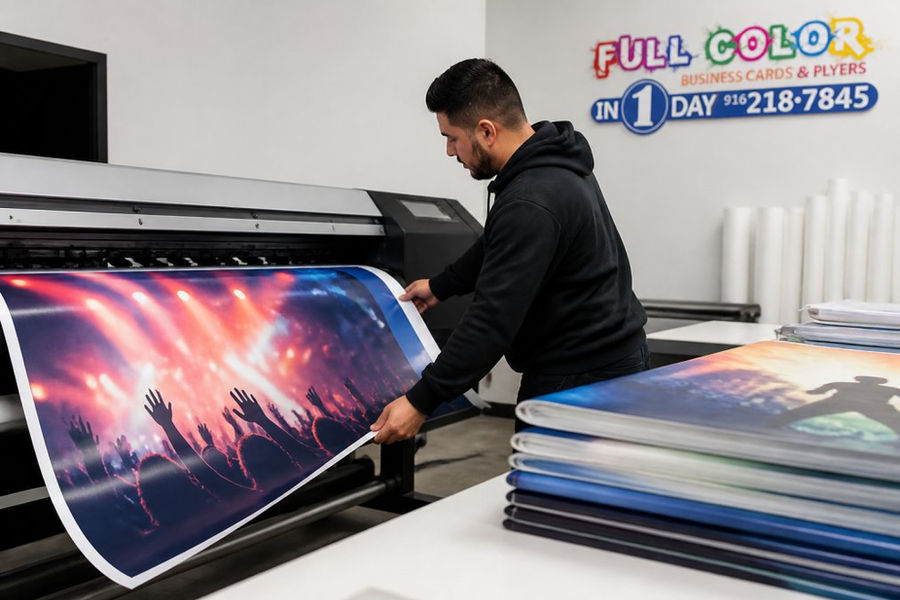
Watch Out Never approve a banner proof on a phone screen. Screen brightness and color profiles misrepresent ink output, and a rejected banner on event morning is a total loss.
Printing Quality Control for Events: Proofing, Color, and Substrate Selection
Printing quality control for events is the set of checks that happen between file submission and delivery: preflight review, proof approval, press calibration, and finishing inspection. Skipping any one of them shifts risk onto event day.
Checkpoint | What It Catches | When It Happens |
File preflight | Missing bleed, low-resolution images | Before production |
Physical proof | Color drift, paper stock mismatch | Before the full run |
Press calibration | Ink density variation | During production |
Finishing inspection | Hem defects, missing grommets | After production |
Cost-Effectiveness for Small and Mid-Size Events
Cost-effectiveness for small and mid-size events rarely comes from the lowest unit price. It comes from avoiding reprints, rush shipping fees, and materials that fail on site.
Sustainability and Reduced Shipping Impact
Recycled and FSC-certified paper stocks. Forest Stewardship Council certification is a recognized chain-of-custody standard, so you can verify a claim rather than take a vendor's word for it (Chain of Custody Certification).
PVC-free banner materials. Traditional vinyl banners are difficult to recycle. PVC-free alternatives, including some polyester and polypropylene substrates, are increasingly stocked by local shops and are worth asking about by name.
Water-based and UV-curable inks. These reduce solvent emissions compared with older solvent ink systems, and many local wide-format shops have moved to them.
Reusable substrates. A rigid substrate or a durable banner material that survives multiple events spreads its footprint across every use.
Pro Tip Request the same job on two substrates and compare durability after the event. Reusable banner material costs more upfront and less across a season of events, and the local shop can show you both samples before you order.
One caveat worth stating plainly: local production is not automatically greener. A local shop running older solvent equipment on virgin vinyl can have a higher impact than a well-run regional facility. The advantage is that you can ask what they stock, and get a responsive answer. That access to information is the real sustainability benefit of buying local.
How Local Printers Integrate with Digital Event Tech and Crisis Planning
Integration with digital event tech is the angle most print guides ignore, and it is where a local shop earns its keep. QR codes on printed collateral bridge physical marketing and your registration or check-in system, and they only work if the printed code scans cleanly.
Minimum print size. A common rule of thumb is that a QR code should be at least 0.8 inches (about 2 cm) square for close-range scanning, and larger for codes read from a distance. A code on a poster read from several feet away needs to scale up accordingly.
Quiet zone. Leave a clear margin around the code. Crowding it with artwork or a border is one of the most common reasons a code fails to scan.
Contrast and substrate. Dark code on a light background scans most reliably. Reflective, glossy, or heavily textured substrates can defeat a phone camera even when the code is technically correct.
Error correction. QR codes carry an error-correction level. Higher levels tolerate more damage or glare but make the code denser. Ask your printer which level they are using if the code will sit on a curved or outdoor surface.
NFC tags. Near-field communication tags can be embedded behind printed pieces so attendees tap a phone to a sign or badge to open a registration page or app. This requires the printer to plan for tag placement and thickness, which is far easier to coordinate in person.
AR triggers. Augmented reality experiences are often launched from a printed image or marker. The print must be sharp and color-accurate for the trigger to register, which makes proofing on the actual substrate essential.
Keep your print-ready source files with the shop. If they already hold your approved files and color profile, a reprint starts from a known-good state instead of a fresh upload.
Confirm the shop's rush policy in advance. Ask what their true same-day cutoff is and whether finishing (hemming, grommets, mounting) can happen in the same window.
Identify a single point of contact. A named person who knows your event beats a general queue when minutes matter.
Budget a contingency. A small reserve for a same-day reprint is cheaper than a failed signage moment.
Frequently Asked Questions
What are the key differences between network and local printing?
Network printers route your job through centralized facilities, often hundreds of miles away. Local printing keeps production nearby, which means shorter lead times, direct communication with the people running your job, and the ability to pick up or receive materials quickly. For events with fixed dates, that difference matters. You can approve a proof, catch a color issue, and get a reprint without waiting on a shipping window.
How does local printing improve turnaround times for events?
Local printing removes the shipping leg from the timeline. When your flyers, banners, or yard signs are produced in the same region, same-day and next-day options become realistic. You can also submit print-ready files later than you would with an online vendor and still hit your event date. For urgent needs, local printing is often the only way to get event signage in hand before doors open.
Why is color accuracy better with a local printing service?
Local printers can show you a physical proof before the full run. You see the actual paper stock, ink coverage, and brand colors under real lighting. If something looks off, adjustments happen before hundreds of pieces are printed. Online vendors rely on digital proofs, which cannot fully represent how ink interacts with a specific substrate. That gap is where washed-out colors and mismatched brand assets come from.
Can local printers help with last-minute event signage changes?
Yes. Local printers handle last-minute changes because you can reach a person, explain the edit, and get a revised proof quickly. If a speaker cancels or a sponsor logo needs updating, the file can be corrected and reprinted without starting a new shipping cycle. Same day event banner printing exists precisely for these situations. The key is submitting print-ready files and confirming the change in writing before production starts.
Event timelines compress, and print is usually the last item confirmed and the first thing needed. Full Color Business Cards and Flyers in 1 Day handles same day and next day printing for business cards, flyers, banners, yard signs, and custom apparel, with semi-custom design support if your files are not ready and responsive customer service that answers within 30 minutes. Submit your order online and get your event materials produced locally, on schedule.
See Pricing Today


Comments