

5 Best Event Promotion Materials for Startups: A Ranked Guide
Last Updated: November 19, 2026
Quick Summary
The five best event promotion materials for startups, ranked by return on a lean budget, are banners and signage, flyers and brochures, business cards, promotional giveaways, and printed programs with name badges and invitations. Order signage first for booth visibility, then flyers and cards for lead capture.
Banners and event signage are the highest-use print spend because they work before anyone talks to you.
Plan business cards at 1.5x the attendees you will actually meet and flyers at 0.5x.
Consumers' most-wanted promo items include T-shirts at 45%, hoodies at 40%, and pens at 38%.
Submit print-ready files three weeks out and approve proofs two weeks before the event.
Post-event follow-up within 48 hours is where most conversion happens.
Need event materials before the doors open?
Same-day and next-day printing for banners, flyers, cards, and apparel with design support.
Table of Contents
Why Event Promotion Materials Still Decide Startup ROI
According to Cvent's event statistics compilation, 72% of marketers say events are the most effective marketing channel for their organizations.
Digital promotion gets the measurement credit, but the booth still runs on print. A QR code on a banner, a flyer with a landing page, a business card someone keeps: each is a measurable touchpoint if you build it that way.
Below, we rank the five best event promotion materials for startups by cost efficiency, production effort, and event ROI, assuming one budget and one event date.
The 5 Best Event Promotion Materials, Ranked

Ranked by return on a lean budget, the five best event promotion materials for startups are banners and signage, flyers and brochures, business cards, promotional giveaways, and printed programs with name badges and invitations. Each earns its place for a different reason, and each has a failure mode worth knowing before you order.
Material | Typical Priority | Production Effort | Best For |
Banners and signage | First | Low | Booth visibility |
Flyers and brochures | Second | Low | Carrying your pitch |
Business cards | Third | Very low | Networking follow-up |
Promotional items | Fourth | Medium | Brand recall |
Programs, badges, invitations | Fifth | Medium | Hosted events |
1. Banners and Event Signage: Maximum Visibility per Dollar
Banners and event signage are the highest-use print spend for a startup because they work before anyone talks to you.
Order these first. Signage is what 4OVER4's event materials guidance treats as the high-impact item to prioritize when allocating a print budget. Our guide to avoiding event banner size mistakes covers the measurements before you order.
Best for: startups whose event goal is brand visibility and booth traffic. Skip if: you are attending as a guest with no booth presence.
2. Flyers and Brochures: The Handout That Carries Your Pitch
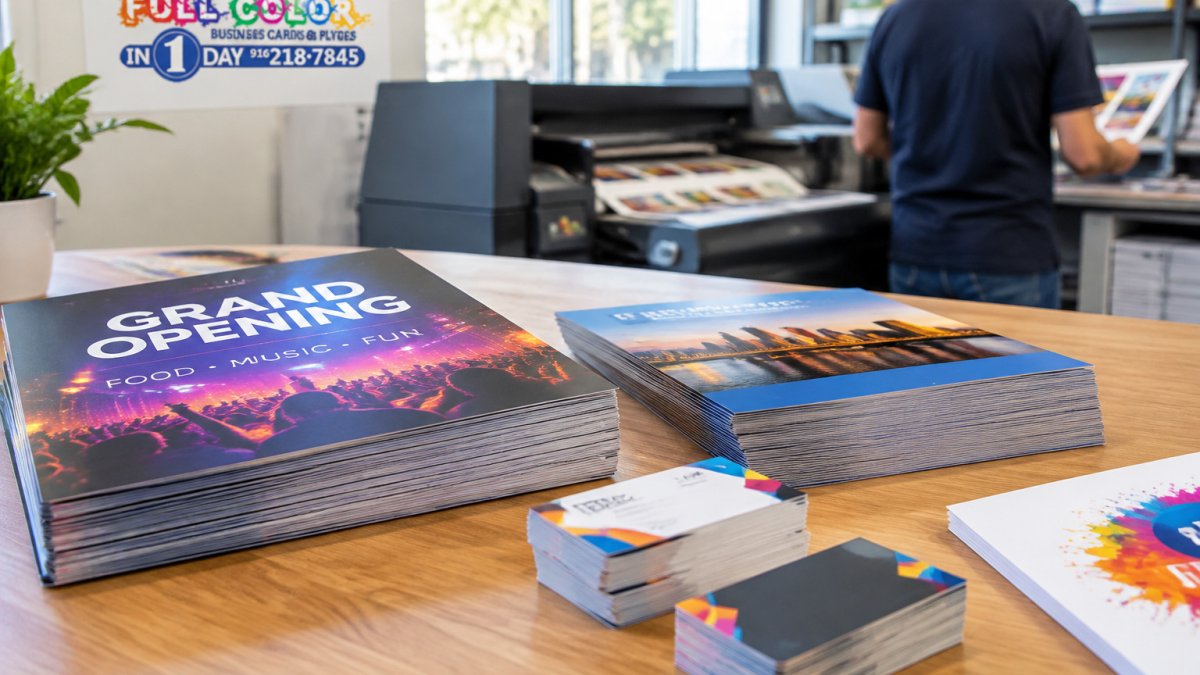
Flyers and brochures keep selling after the conversation ends. A one-page flyer with your offer, a QR code to a landing page, and three proof points covers most startup pitches.
Print quality decides whether the handout survives the trip home. Paper weight, color mode, and resolution all affect how sharp the piece looks in hand, and our guide to the best print quality for flyers explains each setting.
Best for: startups with a clear offer and a landing page to point to. Skip if: your product needs a demo to make sense.
3. Business Cards and Networking Materials
Business cards remain the cheapest conversation starter in event marketing. They cost little per unit, fit in a pocket, and carry what a badge scan cannot: a reason to follow up.
Card stock also signals your brand before anyone reads the title. Comparing business card paper types by weight and finish takes ten minutes and prevents the flimsy-card problem that makes a startup look temporary.
Best for: every founder attending any event, always. Skip if: never. Bring cards.
4. Promotional Items for Conferences and Giveaways
Promotional items for conferences work when they match what attendees actually want. According to VistaPrint's promotional products trends, consumers' most-wanted items include T-shirts at 45%, hoodies at 40%, pens at 38%, mugs at 34%, and tote bags at 34%.
Apparel is the highest-recall giveaway and the highest-effort one. Decoration method, bulk pricing, and turnaround all change the math, which is why we published a guide to custom apparel printing for businesses.
Best for: events with high foot traffic and a defined audience. Skip if: your budget only covers a small, senior audience where cards do the work.
5. Printed Programs, Name Badges, and Invitations
Printed programs, name badges, and invitations are the materials that make a hosted event feel organized. If you are running a demo night, a workshop, or a customer dinner, these pieces carry the logistics: who is speaking, where to sit, who is in the room.
Name badges break the ice before you reach the table. Speaker thank-you cards are a small, cheap touch that builds a relationship worth more than the card cost.
Best for: startups hosting their own event rather than attending one. Skip if: you are only exhibiting at someone else's show.
Event Collateral Examples by Event Type
The right event collateral examples change with the format. Trade shows reward banners, business cards, and booth giveaways, while conferences lean on programs, name badges, and speaker thank-you cards, a split that 4OVER4's event material breakdown describes directly.
Trade show booth: retractable banner, table signage, business cards, one giveaway, flyers for the pitch.
Conference attendance: business cards, a slim brochure, stickers, a QR code to your landing page.
Hosted workshop: printed programs, name badges, invitations, thank-you cards for speakers.
Customer dinner: invitations, place cards, a small branded gift, follow-up cards.
Match the material set to the format before you order anything. Ordering trade show signage for a seated dinner wastes the budget.
Build Your Event Marketing Plan Template Around These Materials
An event marketing plan template is a one-page document that ties each material to a goal, a quantity, a measurement method, and a dollar limit.
Start with cost per attendee: divide your total event spend (print, booth fees, travel, staff time) by the number of attendees you expect to meet.
Here is how to fill in the template, line by line.
Set one primary goal. Visibility, qualified leads, or meetings booked. Pick one. A secondary goal is fine, but it does not get its own budget line.
Assign materials to the goal. Signage for visibility, flyers and cards for leads, programs and badges for hosted events. If a material does not serve the primary goal, it waits for the next event.
Set quantities from attendance, not optimism. Plan business cards at 1.5x the attendees you will actually meet, flyers at 0.5x, and giveaways at 0.3x to 0.5x. Check the next vendor quantity break before finalizing: moving from 250 to 500 flyers often costs less per unit, but only order the larger run if the extra pieces have a post-event use.
Attach a measurement method. A unique QR code per material, a tracked landing page, or a "how did you hear about us" field. One code per piece is the difference between knowing which material worked and guessing.
Set a dollar limit per line and a total. Write the number down. The template's job is to stop the mid-order upgrade to premium paper that eats the giveaway budget.
Set the order date. Work backward from the event date and leave a buffer for reprints. Same-day and next-day printing exists, but it costs more and narrows your options.
Watch out: minimum order quantities are where startup budgets leak.
A worked example: suppose you expect to meet 200 attendees at a one-day conference and your total event budget is $3,000.
How to Measure Event Marketing ROI on a Lean Budget
Event marketing ROI is the revenue attributed to an event divided by the total cost of attending, including print, booth fees, travel, and staff time.
Start with the production timeline, because a material that misses the event has an ROI of zero. Work backward from the event date with these checkpoints:
Four to six weeks out: finalize the material list against your goal, confirm quantities, and request quotes. Custom apparel and large-format signage have the longest lead times.
Three weeks out: submit print-ready files. Confirm bleed, trim size, color mode, and resolution before upload. A file that fails preflight costs a day or more.
Two weeks out: approve proofs. Check every phone number, URL, QR code, and date on the proof, not on the screen. A QR code that points to the wrong landing page is the most expensive typo in event print.
One week out: confirm shipping address and delivery date. If the event is out of town, ship to the hotel or venue with a hold-at-desk instruction, and pack a small backup kit of cards and flyers in carry-on luggage.
Day before: assemble the booth kit: banner stands, tape, scissors, card holder, and a printed copy of the measurement plan.
Watch out: shipping delays are the most common reason a startup's materials arrive after the doors open.
Once the event runs, track three numbers per event: cost per lead, conversion rate from lead to meeting, and pipeline value. A QR code on each material gives you attribution without expensive software. Post-event follow-up within 48 hours is where most conversion happens, and where lean teams often drop the ball. Send a short follow-up that references the conversation and includes the same landing page the QR code pointed to, so attribution stays clean.
Attribution works best when the physical and digital paths share one destination.
Pipeline, not badge scans, is the number that matters. Review campaign performance after every event, compare cost per lead against your template estimate, and cut the materials that never produce a scan or a conversation.
Submit Your Order Before Your Next Event
The hardest part of event promotion is not choosing the materials. It is getting them printed, correct, and in your hands before the doors open.
Full Color Business Cards and Flyers in 1 Day exists for exactly that problem. If you are planning around a date, our guide to same day printing for events walks through file prep and ordering.
Your next event date is already on the calendar, and print lead time is the one variable you control.
Frequently Asked Questions
What promotional materials should a startup bring to an event?
Start with the five that do the most work: a banner or booth signage for visibility, flyers or brochures for your pitch, business cards for networking, one or two giveaway items, and any printed programs or name badges the event requires. The materials you carry should support conversation and follow-up rather than fill a table. Order in small batches first and restock what attendees actually take.
How can startups promote an event on a small budget?
Prioritize visibility and contact capture over volume. A single well-placed banner and a sharp business card cost less than a table full of novelty giveaways and often generate more qualified leads. A small run of one practical item usually beats a large run of something nobody keeps. Pricing depends on quantity and turnaround, so check current rates on our website before you commit.
How do you measure the ROI of event promotion materials?
Put a trackable call to action on every piece. A QR code on your banner, flyer and business card that leads to a dedicated landing page lets you count scans, form fills and booked calls per material. Compare that against what you spent on each item to get cost per lead, then compare cost per lead to your close rate. Attribution is what separates repeating a spend from guessing.
What promotional items are useful at conferences?
Useful beats clever. Pens, tote bags and mugs show up in and they tend to get used after the event instead of thrown away. Pair one practical item with a printed program or name badge if the conference requires it, and keep a small supply of stickers for quick booth engagement. Skip anything bulky that attendees have to carry around all day.
How far in advance should a startup order event materials?
Work backward from the event date and leave a buffer for proofs and reprints. Banners and signage need the most lead time because a sizing or color error is expensive to fix, while business cards and flyers can often be turned around in a day when you have print-ready files. Confirm the production schedule when you order, and keep a digital backup of every file so a reprint does not restart the design process.
Comments