

How to Order Custom Yard Signs: A 2026 Step-by-Step Guide
Table of Contents
What You'll Need Before You Order Custom Yard Signs
Print-Ready Files, Vector Graphics, and Resolution Requirements
Step 1: Pick the Best Yard Sign Sizes for Business and Events
Standard Signage Dimensions: 18x24 and 24x36
Step 2: Apply Custom Yard Sign Design Tips for Readability
Single-Sided vs. Double-Sided Printing
Step 3: Choose a Material That Survives the Weather
Corrugated Plastic, Fluted Plastic, and Laminate Finish
Matching Material to Mounting Hardware
Step 4: Upload Artwork, Review the Digital Proof, and Approve
Step 5: Understand Yard Sign Printing Turnaround Time and Shipping
Step 6: Order Stakes, Mounting Hardware, and Bulk Quantities
Bulk Order Pricing Tiers
Step 7: Check Local Sign Rules Before You Install
How to Find Your Local Rules
HOA and Landlord Restrictions
What Happens If You Skip This Step
Getting Your Signs Printed Fast
Frequently Asked Questions
Last Updated: October 4, 2026
What You'll Need Before You Order Custom Yard Signs
Ordering custom yard signs starts with one file: a print-ready design at the correct size and resolution. Get it right and everything moves fast; skip it and you pay in reprints, delays, and washed-out color.
Most rush orders share one problem: a great idea, a tight deadline, and a logo pulled off a website. That logo will not print sharp. Gather this first:
Your logo in vector format, or the largest file you have
Exact text, spelled out and proofread twice
A phone number, website, or QR code you want scanned
Print-Ready Files, Vector Graphics, and Resolution Requirements
Print-ready means the file needs no edits before it hits the press.
Aim for 300 DPI at full print size: a logo that looks fine on a phone screen turns soft and blocky at 24x36 inches.
Most print shops offer digital proofing before the run: you see the layout, colors, and trim lines on screen, then approve, catching typos and low-resolution images before they cost you money.
Watch Out Never send a screenshot or a photo of your logo. Those files carry screen resolution, not print resolution, and the final sign will look fuzzy from ten feet away.
Step 1: Pick the Best Yard Sign Sizes for Business and Events
The best yard sign size depends on viewing distance. A sign read from a passing car needs bigger text than one read from a sidewalk.
For most business promotion and events, 18x24 inches is the workhorse: it fits standard yard sign stakes, ships cheap, and reads clearly from 20 to 30 feet.
The U.S. Small Business Administration's marketing guidance notes that clear, legible messaging matters more than sheer size for local visibility.
Match the size to the job:
18x24: open houses, elections, storefront promos
24x36: grand openings, roadside directions, big events
12x18: directional arrows and parking signs
Standard Signage Dimensions: 18x24 and 24x36
These two sizes cover most orders. Signage dimensions of 18x24 are the default for political campaign signs and real estate; 24x36 suits business promotion where speed of reading matters.
Stick with standard sizes: custom cuts add cost and time, while standard sizes fit off-the-shelf mounting hardware.
Step 2: Apply Custom Yard Sign Design Tips for Readability
Good yard signs follow one rule: less is more. A driver has about three seconds to read your sign, so every element must earn its place.
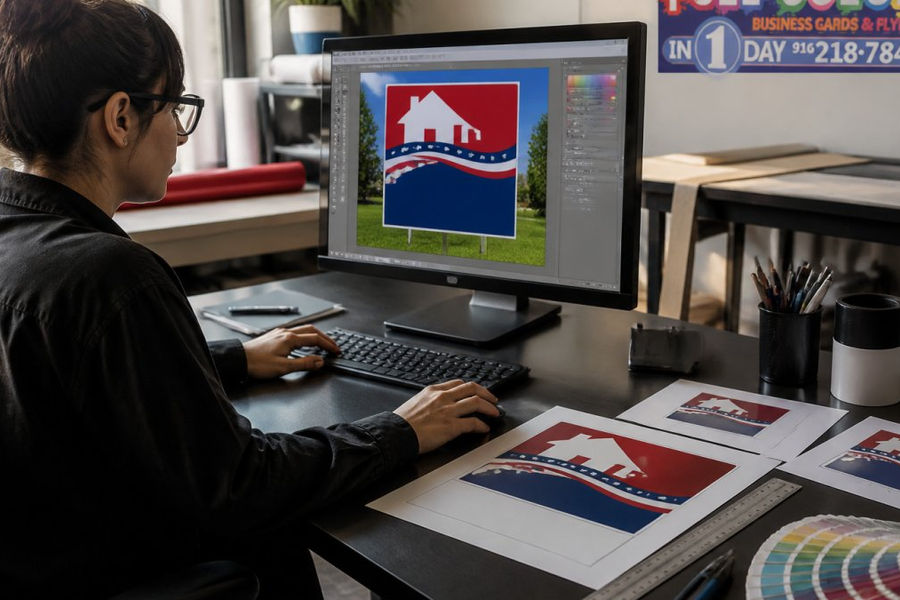
Here are the custom yard sign design tips that matter most:
Keep it to six words or fewer
Use one bold headline and one clear action
Pick high-contrast colors (dark on light, or light on dark)
Contrast beats creativity: a strong color block and clean full-color printing read from farther away than a busy design.
Single-Sided vs. Double-Sided Printing
Single-sided signs face one direction. Double-sided signs carry your message on both faces, which matters when traffic passes on two sides or a sign sits at an intersection.
Choose double-sided when:
The sign faces two-way traffic
It sits at a corner or median
You want one sign to do the work of two
Choose single-sided when the sign backs against a wall, fence, or building. You save money and lose nothing.
Pro Tip For double-sided signs, keep the back design simple. A bold logo and one line of text on the reverse often outperforms a full copy of the front.
Step 3: Choose a Material That Survives the Weather
The default material for outdoor signs is corrugated plastic, also called coroplast or fluted plastic. It is lightweight, waterproof, and holds up through rain, sun, and wind; the hollow flutes keep it rigid yet light enough for a single H-wire stake.
But the wrong substrate is the most common reason a sign fails early. Match material to job:
Material | Typical Lifespan Outdoors | Best For | Weather Resistance | Mounting | Notes |
Corrugated plastic (4mm) | One season to about a year | Most yard signs, campaigns, open houses | Good | H-wire or step stake | Light, inexpensive, reusable if stored flat |
Corrugated plastic (10mm) | One to two years | Larger signs, windy sites | Better | H-wire stake, heavier frame | Thicker flutes resist bowing and flutter |
Laminated corrugated | Two years or more | Long campaigns, real estate listings | Very good | H-wire stake | Gloss or matte film blocks UV and scratches |
Aluminum | Five years or more | Permanent business signage, wayfinding | Excellent | Posts, brackets, grommets | Heavier, dents, costs more; not for staking into grass |
Rigid PVC | Three to five years | Premium indoor/outdoor displays | Very good | Frames, brackets | Heavier than corrugated, smooth print surface |
Vinyl banner material | One to three years | Fence wraps, temporary walls | Good | Zip ties, grommets | Flexible, not self-supporting; needs a frame or fence |
A few selection rules of thumb:
Two-week campaign or one event: 4mm corrugated, unlaminated. Cheapest option that still looks sharp.
Election cycle or multi-month listing: laminated corrugated. The film is what stops the sun from bleaching your colors.
Sign that stays up year-round: aluminum. Corrugated will eventually crack at the stake holes.
Corrugated Plastic, Fluted Plastic, and Laminate Finish
A laminate finish adds a protective layer over the printed surface, guarding against scratches and UV fading. Plain corrugated is fine for a two-week campaign; for months of display, spend the extra on lamination.
Weather-resistant and UV-resistant inks also slow fading, so ask what your printer uses. Solvent and UV-cure inks hold color longer outdoors than standard aqueous inks, if your sign faces direct afternoon sun, this matters more than substrate thickness.
Pro Tip Ask your printer which ink set they run on corrugated. A laminated sign printed with a UV-cure ink will outlast an unlaminated sign printed with a standard ink by a wide margin, even at the same thickness.
Matching Material to Mounting Hardware
Substrate and stake must work together. Corrugated signs are staked through the flutes with H-wire or step stakes; aluminum signs mount to posts or brackets; vinyl banners need grommets and a frame, fence, or wall. The wrong combination cracks the sign at the stake holes or sends it sailing off in the first gust.
Watch Out Do not stake an aluminum sign into grass. The stake holes will tear, and the sign will bend. Aluminum belongs on posts or brackets.
Step 4: Upload Artwork, Review the Digital Proof, and Approve
The artwork upload step is where most delays happen. Send the wrong file and the job stalls while someone fixes it.
Follow this order:
Name your file clearly (businessname-18x24.pdf)
Upload the highest-resolution version you have
Note any color matches or brand colors
Wait for the digital proof
Read the proof line by line, then approve
Check the proof for spelling, phone numbers, and spacing. Once you approve it, the file goes to press.
If you are not a designer, ask about graphic design services or semi-custom design. Many printers can build a clean layout from your logo and text.
Key Takeaway The proof is your last cheap chance to catch a mistake. A five-minute review beats a rushed reprint every time.
Step 5: Understand Yard Sign Printing Turnaround Time and Shipping
Yard sign printing turnaround time is the gap between approved proof and finished signs. It varies by shop, quantity, and material.
Standard turnaround runs a few business days; rush and same-day options exist for tight deadlines, though they usually cost more.
A few things speed up the process:
A print-ready file with no edits needed
Standard sizes and materials
A single-sided design
Shipping costs depend on weight and distance. Corrugated signs are light, so shipping is often cheap. If you are local, same-day pickup or delivery removes shipping entirely.
Step 6: Order Stakes, Mounting Hardware, and Bulk Quantities
Signs need support. Yard sign stakes come in a few styles, and the right one depends on your ground.
H-wire stakes: the standard for corrugated signs, push into grass
Step stakes: shorter, for hard or rocky ground
Metal frames: reusable, good for long campaigns
Mounting hardware also includes grommets and zip ties for fence mounting. Ask what your sign ships with, since not every order includes stakes.
Bulk Order Pricing Tiers
A bulk order lowers the cost per sign: setup costs spread across more units, so 50 signs cost well below a run of 10 per sign.
Plan quantity around the campaign, not the moment. Extra signs cost little at bulk rates and save a second order later; for wholesale printing or large runs, ask for a quote on your full count.
Step 7: Check Local Sign Rules Before You Install
Before you plant a single stake, check the rules. Cities, counties, and homeowner associations set limits on sign size, placement, and how long a sign can stay up.
Most jurisdictions regulate temporary signs through a zoning or land-development code. The rules typically cover:
Maximum size allowed in a residential, commercial, or mixed-use zone
Setback distance from roads, sidewalks, and property lines
Height limits measured from grade to the top of the sign
Rules vary by city and county, so a sign that is fine in one spot may be a violation a block away. Residential zones typically allow smaller signs than commercial zones, and signs in the public right-of-way are prohibited everywhere.
How to Find Your Local Rules
You do not need a lawyer to get this right. A short search will usually surface the answer:
Search your city or county website for "temporary sign ordinance" or "sign code."
Look for the section covering temporary or political signs, not permanent business signage.
Check whether your property is in a historic district or a planned development, which often have stricter rules.
If you rent or live in an HOA, read the covenants, conditions, and restrictions (CC&Rs) before you order.
Call the planning or code enforcement office and ask two questions: what size is allowed, and how long can it stay up.
It is a five-minute call that prevents a fine. If you are ordering for a client or campaign, get the answer in writing so you can pass it along.
HOA and Landlord Restrictions
An HOA can be stricter than the city. Many CC&Rs limit sign size, ban signs in common areas, restrict how many can be displayed at once, and set their own removal deadlines. Some prohibit political signs except during a defined window before an election, and your lease may restrict signs if you rent.
Watch Out A sign that complies with city code can still violate your HOA rules. Check both before you order, not after the sign is printed.
What Happens If You Skip This Step
Code enforcement officers typically issue a warning or removal notice first, but repeat violations can carry fines, and the city may remove the sign at your expense. For a political campaign, a removal notice in the final week costs you the visibility you paid for; for a business, a fine plus a reprint is a double loss.
Key Takeaway Check the city code and the HOA rules before you place the order. The size and quantity limits may change what you buy, and it is far cheaper to adjust the order than to pull signs off the ground.
Getting Your Signs Printed Fast
Deadlines do not move, and a campaign that launches late loses its window. Full Color Business Cards and Flyers in 1 Day handles same-day and next-day printing for custom yard signs, plus business cards, flyers, banners, and more. We offer semi-custom design, digital proofing, and local pickup or delivery, with a 30-minute email response time when something needs fixing. Submit your order online and get signs that are ready when you are.
Frequently Asked Questions
What is the average cost of a custom yard sign?
Cost depends on size, material, print method, and quantity. A single 18x24 corrugated plastic sign with one-color printing costs less per unit than a double-sided laminated sign, and bulk orders lower the per-sign price. Most printers price by tier, so ordering 50 signs costs more in total but less per sign than ordering 10. Check the printer's pricing page for current rates, since quotes change with material and turnaround speed.
What materials are best for outdoor yard signs?
Corrugated plastic, also called fluted plastic, is the standard for outdoor yard signs because it is lightweight, weather-resistant, and holds up to rain and sun. A UV-resistant laminate finish adds protection against fading and scratches. For short-term use, thinner 4mm corrugated plastic works fine. For signs that stay up for months, choose a thicker board and add lamination. Paper and foam board are not suitable outdoors.
How do I choose the right size for a custom yard sign?
The most common sizes are 18x24 and 24x36 inches. An 18x24 sign works for residential lawns, real estate listings, and directional signage where viewers are close. A 24x36 sign suits busy roads, political campaign signs, and event promotion where the sign must be read from a distance. Match the size to viewing distance: the farther away the audience, the larger the sign and lettering need to be.
Can I get custom yard signs printed and delivered the same day?
Same-day and next-day printing is possible with a local print shop that offers on-demand production. Submit print-ready files or approved artwork early in the day, confirm the digital proof quickly, and choose local pickup to avoid shipping time. If you need signs for an event tomorrow, ask about same-day pickup before you order. Turnaround depends on file readiness, quantity, and whether the shop has the material in stock.
See Pricing Today


Comments